
InPrivate browsing in Edge is similar to Chrome’s Incognito mode. InPrivate browsing or tabs is a useful feature when you don’t want Edge to store your browsing history, site data or cookies and to block trackers. However, this feature can be misused when you share your PC with minors or kids. They can use it to hide their online activity. InPrivate browsing in Microsoft Edge browser is similar to the incognito mode. When this feature is enabled, the web browser does not save the cookies, history or temporary files once you are done with the browsing. So i you do not want to let others know the websites you are searching, you can use this feature.
InPrivate browsing in Edge is similar to Chrome’s Incognito mode. InPrivate browsing or tabs is a useful feature when you don’t want Edge to store your browsing history, site data or cookies and to block trackers.
However, this feature can be misused when you share your PC with minors or kids. They can use it to hide their online activity. If you don’t want private browsing in Microsoft Edge then you can use the steps described below to block access to InPrivate mode in Edge.
RECOMMENDED: Disable access to Incognito mode in Google Chrome
Step 1

Close all the instances of the Edge browser before proceeding with these steps.
Go to the taskbar search box and search for the Registry Editor app. Right Click on the app in the search results and click on Run as Administrator.
Step 2
In the Registry Editor navigate to the following path:
Right Click on Microsoft Folder and in the context menu, select New > Key.
Name this new key Edge.
This will create an Edge Folder under the main Microsoft Folder. With the Edge folder selected, the address bar in registry editor should show the following path
Step 3
Now Right click anywhere in the empty space on the right side. Select, New > DWORD (32-bit) Value. (Make sure that you are selecting, DWORD (32-bit) Value even if you are running Edge on a 64-bit PC.)
Rename this New key to InPrivateModeAvailability
Step 4
Double click this InPrivateModeAvailability key you just created and set its value to 1, if it is set to 0 or any other value. This setting has to be set to 1 for InPrivate browsing to be disabled in Edge.
Click on OK and close the registry editor and restart your PC.
This should disable the New InPrivate window option in Microsoft Edge’s menu.
Re Enable InPrivate Browsing
If you want to re-enable the InPrivate window then go back to the Registry key, InPrivateModeAvailability, we created in the steps above and set its value to 0. This would bring back the InPrivate window in Edge.
RECOMMENDED:Block a Program from Accessing the Internet in Windows 10
RECOMMENDED: Read aloud Webpages in Android using Google Assistant
Recommended
You might have heard about private or incognito browsing. It’s the mode that doesn’t store anything in history. While it does store cookies, they are deleted after the session is exited.
This mode is known as Incognito browsing in Google Chrome, Private Browsing in Mozilla Firefox, and InPrivate Browsing in Internet Explorer. Whatever you may want to call it, the mode works the same in all browsers.
There are some browsers like Kingpin that work exclusively in Incognito mode so your history is never saved.
However, sometimes you might want to go back to a page that you previously opened. You saw a good recipe for the chicken casserole and thought you don’t have the time for this. Today your kids are coming over and you wish you had that recipe.

The question is – can you check your incognito history?
Problem is, there is no easy way to go back to that page. So the chicken casserole recipe you saw is effectively lost. Unless you can Google it up and it shows again. But if it’s not there on the first page of Google, it’s gone forever.
But if you’re a little tech-savvy, you can still get to know about the websites that have been browsed under the incognito mode.
Yep, the private browsing mode has a loophole. You can see the browsing history of someone using incognito mode but only if you have access to their computer. Also, they must be using the Windows operating system.
How to See Incognito History
Watch this video on YouTube
While incognito can protect you from most prying eyes, it won’t be able to protect you if someone went snooping into your DNS queries. Since these DNS queries are stored and can be accessed on a Windows device, you can find out a user’s browsing session’s details.
How DNS Works
A DNS server, or Domain Name System server, is a device that records the IP address and their hostnames. So when you enter the name of a website in the browser, the browser will check the DNS server and get the IP address of the site to open it.
This entire process of communication between the browser and the DNS server gets recorded on your device – even if you’ve used private browsing.
Now if you read the DNS results, it will show the browsing history of your computer. And it’s pretty simple to see the DNS results – you don’t have to be a bigshot hacker for this.
🔧 How to test this:
Open a website using incognito mode or Kingpin browser. Check the history and you’ll see it’s not present in the history list of the browser.
- Now click on the Windows icon given on the bottom left corner.
- Look for the command prompt. You can invoke it by typing cmd.
- Run the Command prompt as an administrator.
- You’ll see a black DOS window open up.
- Type ipconfig/displaydns>any locationfilename
- For example, let’s say you want to save the results in a text file called kingpin123.txt in D: drive.
- Type ipconfig/displaydns>D:kingpin123.txt
- Close the command prompt
Go to the D: drive and you’ll see kingpin123.txt there. Open it and it will show the website you recently opened that didn’t show up in history.
As you can see, your history might not be easily available when you use incognito, but it’s still right there.
How to Delete Incognito History
🔧 To delete that history, you can take the following steps:
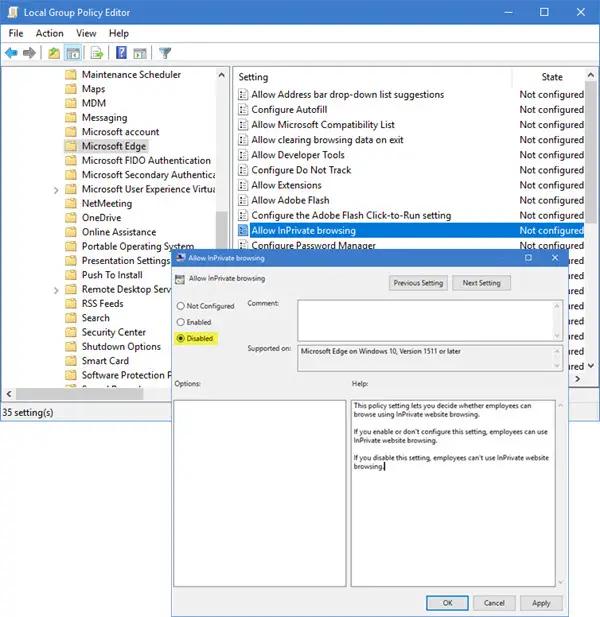
Edge Inprivate Mode
- Click on the Windows icon on the bottom right corner of the screen.
- Open the command prompt by following the same steps as above. Make sure you run it as an administrator.
- Type ipconfig/flushdns
This will flush the DNS entries and nobody will be able to see the websites you have visited.
So you’ve just flushed the DNS and you always use the incognito mode. Does that mean nobody can spy on your activities?
Not really. Even if you’ve covered your tracks, there’s a small bit of malware that can steal your passwords and other data.
Edge In Private Browsing Mode

A keylogger is a software that monitors your keystrokes, mouse movements, and screen activities. While there are hardware keyloggers as well, most of them are software based these days.
Keyloggers are pesky and crafty. You won’t even get to know you have one. It will not show up on the programs list. And it will not show up in the task manager. It works stealthily and records all keys and takes regular screenshots.
These sneaky tools are so well-hidden that they are not detected by many antivirus and anti-malware software. While it’s not entirely impossible to detect the presence of a keylogger, it’s difficult nonetheless.
What you can do is not grant your device access to strangers. It’s best to keep it locked with a secure password or code.
How to achieve 100% privacy and security
In effect, you can never achieve 100% security. No matter what you do, the hackers will find a loophole to get to your data. It depends on their dedication and the perceived value of your data. You can keep increasing the security and they will keep coming up with ways to break it.

Let’s understand it this way.
You have a house and you install a lock on it. The burglars really want your data so they come up with a saw to break the lock.
You install deadbolts and they come up with a way to break the doors. You install a fence and they will devise ways to jump over it. You install guns around your house and they come with a bulldozer to break down your house and take your possessions.
So no matter what you do, you cannot achieve 100% security.
What you can do it follow the measures that are available to you. Use Tor. And use a VPN to make sure your data in transit is secure. Install a good antivirus and anti-malware software on your device.
Use incognito mode – all the time. Better still, use a browser that offers incognito by default so you don’t accidentally “forget opening an incognito window.”
Related Posts: